Welcome to the Nanomagnetic Biosensors & Devices Group!
Led by Prof. Kai Wu, the Wu Lab is dedicated to advancing healthcare technologies through innovations in magnetic nanomaterials, spintronic devices, and intelligent sensing systems. Our interdisciplinary research integrates circuit design, physics, materials science, biology, and artificial intelligence to develop next-generation platforms for disease diagnosis and treatment. A key focus of our lab is developing spintronic devices for in-sensor computing, where sensing and computation are integrated directly in hardware to enable edge AI for healthcare applications, including neural sensing and wearable biomedical systems.
Our current research focuses on:
- Magnetic nanomaterials and spintronic nanodevices for biomedical applications;
- Wearable biosensors, including magnetic and optical sensing platforms;
- Magnetic particle imaging (MPI) and magnetic resonance imaging (MRI);
- In-sensor computing and edge AI for healthcare.
We aim to translate fundamental discoveries into practical medical technologies and welcome students and collaborators interested in interdisciplinary research at the intersection of nanotechnology, AI, and medicine.
Latest News
-
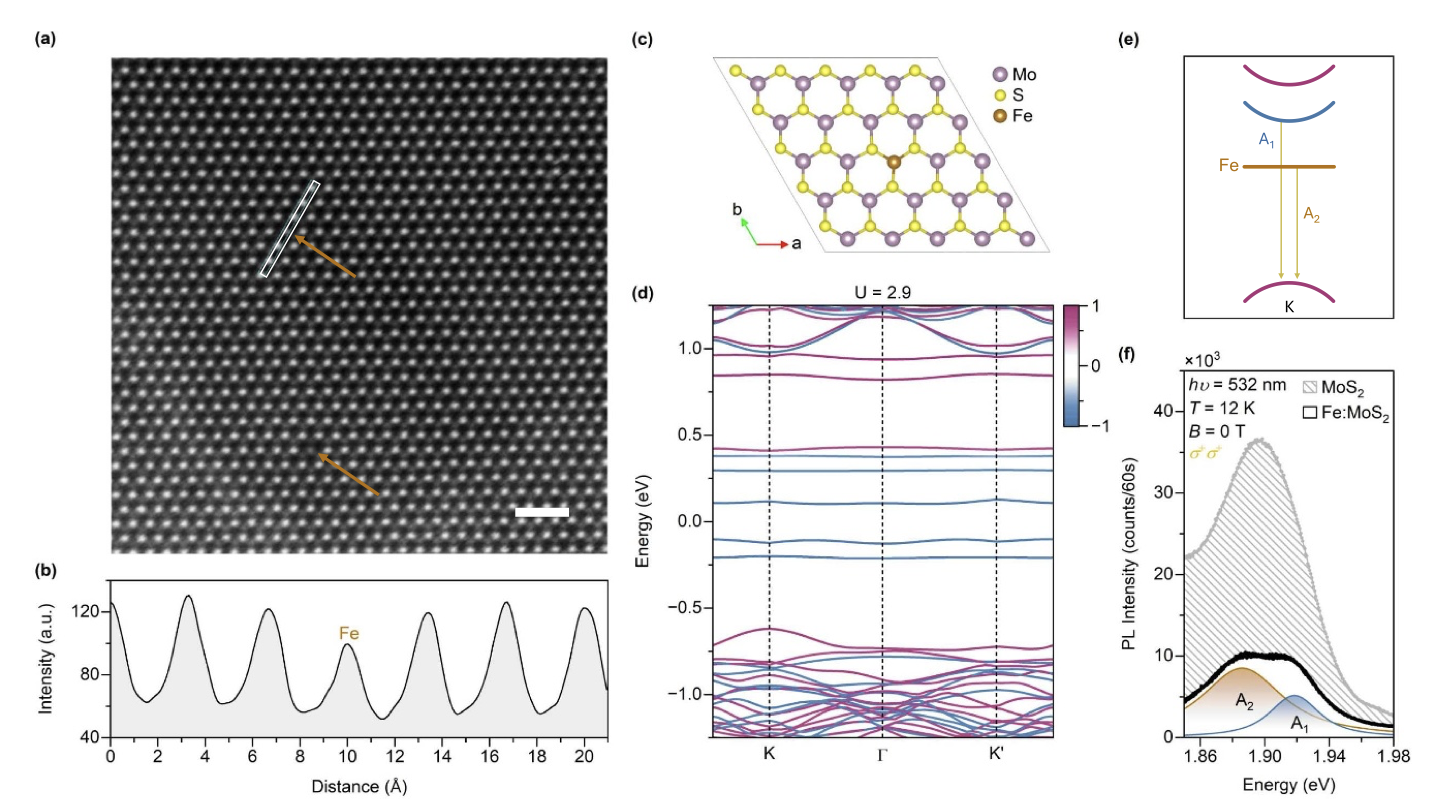
The collaborative paper led by Drs. Rui He and Wencan Jin, titled “Dilute magnetic impurity-induced effective phonon magnetic moment in Fe-doped monolayer MoS2” is now published in 2D Materials! [Read More]
-
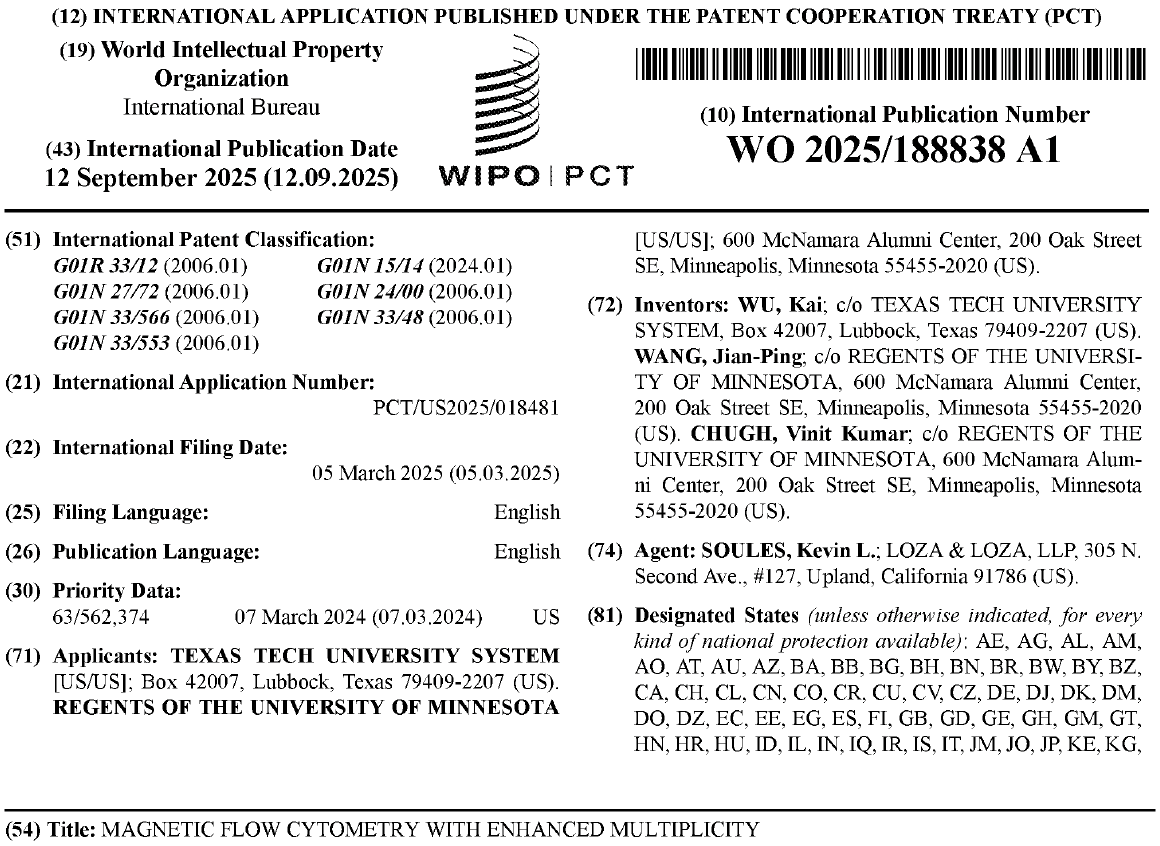
New WO Patent Published Online - WO2025188838A1
Prof. Wu’s WO patent “Magnetic flow cytometry with enhanced multiplicity” was published online. See the patent link: WO2025188838A1. This patent idea was conceived at Texas Tech University. -
We Received Funding from the TTU Office of Research Development & Communications!
Our project titled “SMART-MNPs: Smart Magnetic Nanoparticles for MRI-guided and Adaptive Cancer Therapy” has been selected as an awardee for the Research Assistance Program, FY26, by the TTU Office of Research Development & Communications. [Read More] -
Congratulations to Shahriar on Advancing to PhD Candidacy!
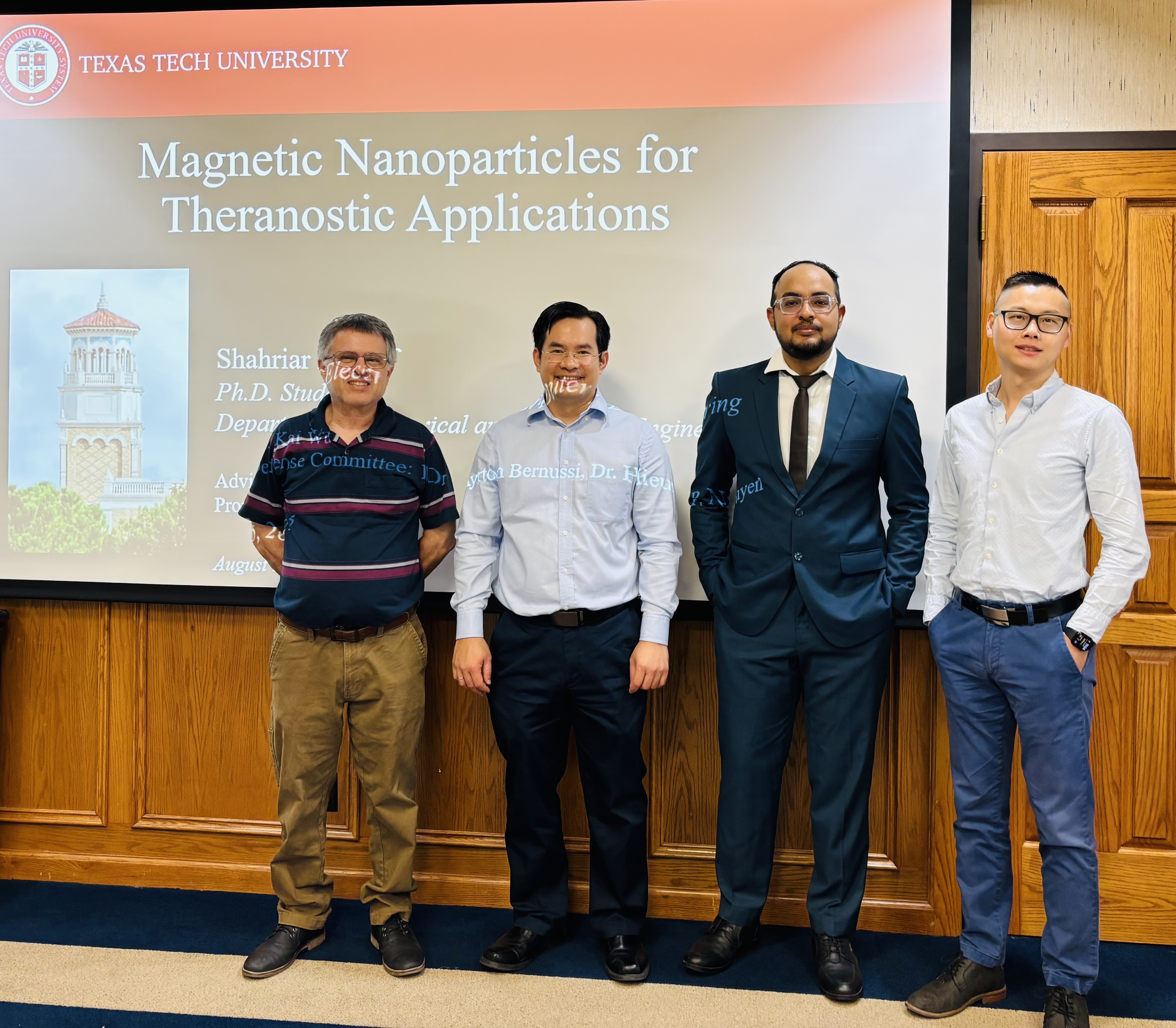
Congratulations to Shahriar for successfully passing his PhD qualifying exam with his proposal titled “Magnetic Nanoparticles for Theranostic Applications.” He is now officially a PhD candidate—a major milestone in his doctoral journey. We look forward to his continued contributions and achievements ahead. [Read More] -
We Are Funded by NIH NIGMS to Develop 3D Printed Magnetic Sensors!
Our lab has been awarded a four-year, $588,371 research grant from the National Institute of General Medical Sciences (NIGMS) of the National Institutes of Health under Award Number R16GM158539. [Read More]
Sponsors